
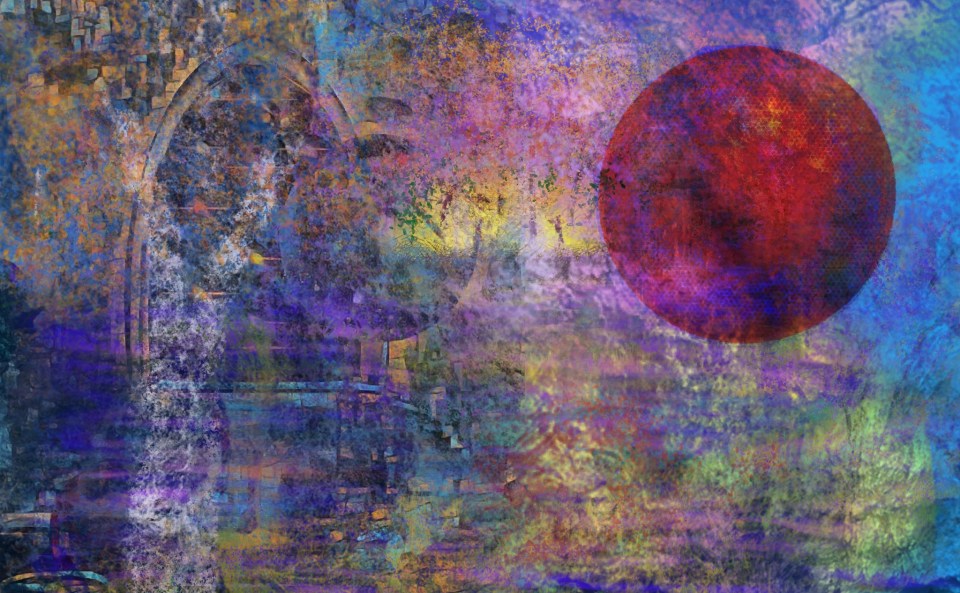
Art is fundamentally an attempt to create and expression meaning through spatial imagery. Art uses various elements in order to do this:
- marks or objects of zero, one, two, or three dimensions (the latter either constructed in three dimensions or projected onto two):
- points,
- lines,
- shapes, and
- forms and,
- light, and more specifically
- hue, the wavelength of the light reflected by the object,
- value, how dark or light it is, and
- intensity: how bright or dull the colors are.
These elements are deployed against a real or represented space of two or three dimensions. They are deployed according to the principles of design:
- emphasis
- balance
- contrast
- repetition
- proportion
- movement
- negative space
- hierarchy
- unity and variety
- harmony
- rhythm
- pattern
Our visual or spatial art is uses a variety of media incuding:
- painting (digital, acrylic, and egg tempera),
- colored pencil, and
- photocollage/photomontage.
Our paintings, drawings, and collages are intended to demonstrate the complex ways in which space is pregnant with meaning. In our more representational work we do this by creating sacred landscapes and cityscapes which bring together elements which are themselves already heavily laden with meaning, such as sanctuaries or markets, in ways which are surprising and thus force the question of meaning. A forest clearing with a church or a city with buildings from diverse historical contexts and periods is not, first and foremost, an absolute space through which physical objects move over time, or even a relativistic space created by the presence of mass, but rather an axiological space constituted by the meanings which order it. Our more abstract work does the same thing through the use of minimalistic traces of symbols or objects with meaning, and through the use of color and value, which themselves carry definite meanings and convey definite moods.
 The Desire to Be God